
🌐 SIRIUS MEDIA | ADVANCED CULTURE & PRESS
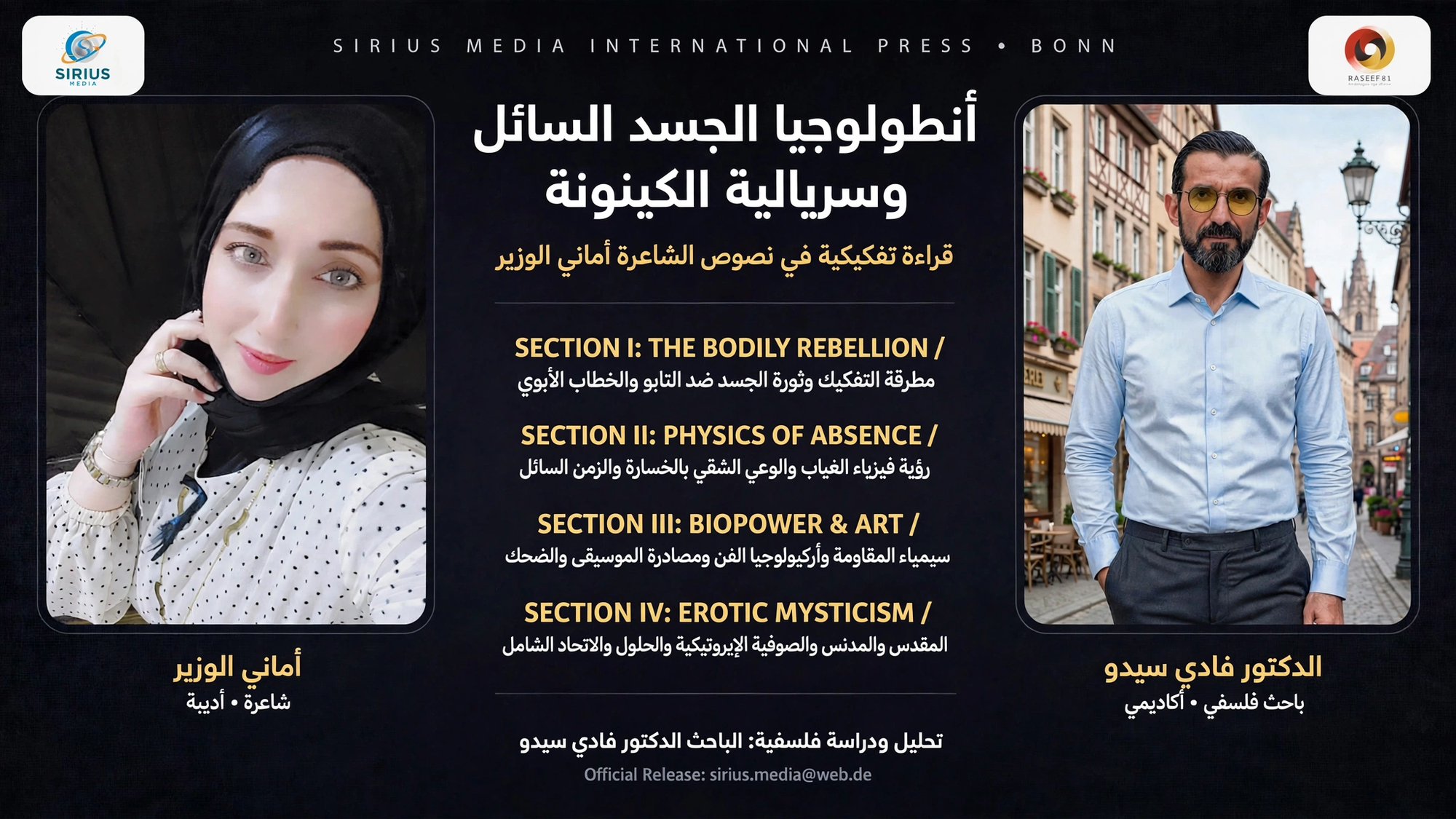
Bonn, Germany — Main Newsroom
International Edition
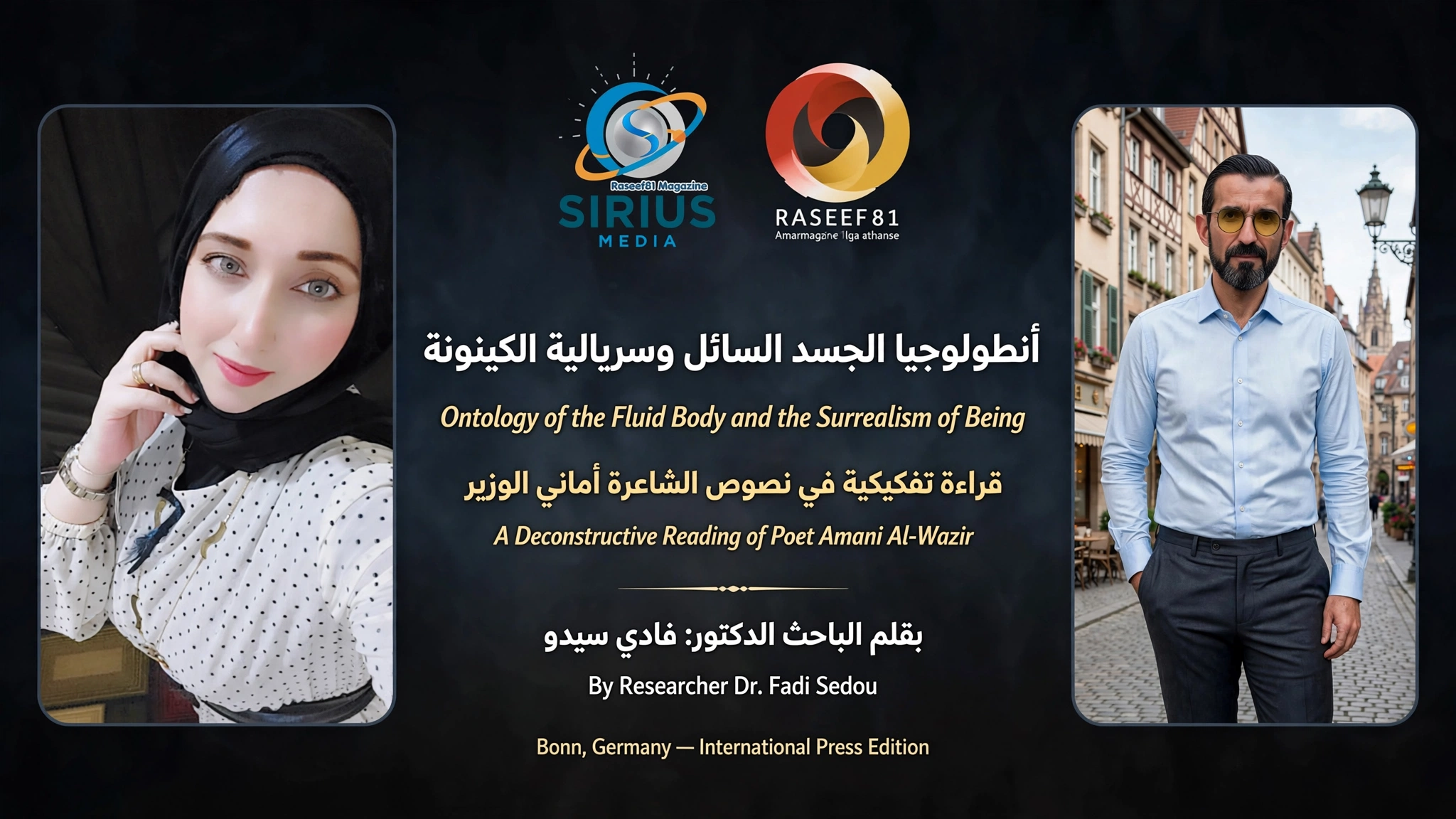
The Ontology of the Fluid Body and the Surrealism of Being: A Deconstructive Reading of Amani Al-Wazir’s Poetics
By Dr. Fadi Seedu
Senior Literary Critic & Cultural Analyst
Sirius Media Headquarters, Bonn
Methodological Introduction: The Threshold of an Alternative Critical Consciousness
In this analytical expose, I refuse to approach the texts of the poet and writer Amani Al-Wazir as mere emotional outbursts or fleeting, subjective confessions. Instead, I redefine her work as an integrated, "revolutionary existential manifesto
In this study, I deploy my specific deconstructive methodology—one that weaves together the avant-garde surrealism of André Breton in liberating the subconscious, the Foucauldian analysis of power and surveillance, and the liquid modernity formulated by Zygmunt Bauman. My ultimate objective is to trace the "archeology of the body and the soul" across five progressive intellectual stages. This journey spans from loud, overt rebellion, through alienation and biopolitics, ultimately arriving at a state of total mystical dissolution. By doing so, I pave the way to shatter the superficial readings that trap casual readers in a web of misinterpretation
Section I: My Deconstructive Hammer and the Bodily Rebellion Against Taboo
I posit that the text "A Woman of Ill Repute" serves as the primary threshold of a grand confrontation with the patriarchal "authorial discourse." In my view, the poet does not merely defend her stance; she actively attacks societal masks by dismantling central dogmas and embracing societal stigma to weaponize it against its very source
Here, I invoke Jean-Paul Sartre’s concept of Authenticity to illustrate how the poetic self rejects being a distorted, willfully castrated entity designed purely to appease the collective consensus. I cite her striking, visceral words that pierced the very core of my critical consciousness
I wanted my body in its entirety, not the version that men left for me after they clipped away desire, and stitched the word 'shame' in its place, as proof that my history was completely devoid of lust
In dissecting the surrealism of the body within this text, I assert that the physical form transcends its closed biological boundaries. It morphs into a cognitive, non-logical space possessing its own sovereign consciousness that rebels against institutional conditioning. This becomes undeniably clear to me when I read her lines
At night... while he slept, my body remained awake. It knew something I had never learned at school: that desire is not a disgrace
I view this chapter of her work as a public exposure of the mechanics that reduce women to a mere deed of ownership or a passive "attendance sheet." The text announces the birth of the feminine Übermensch (the Overman)—an entity complete in self, body, and raw desire, entirely liberated from the need for societal certificates of absolution
Without needing the approval of a cleric, the signature of a father, or the testimony of another man to prove that I am still a respectable woman
Section II: My Perspective on the Physics of Absence and the Unhappy Consciousness of Loss
In this section, I excavate Zygmunt Bauman’s concept of "Liquid Time," observing how inanimate objects lose their neutrality and transform, through my critical lens, into tangible entities heavily charged with living memory
In the text "Since Your Departure...", I explore how the poet alters physical emptiness into a concrete state of matter and the theatrical stage for an absolute existential crime
Since your departure... I have started making the bed as if I am hiding a crime. I pull the cover from your empty side, and pat the pillow that has forgotten the shape of your head
Here, I must urge you to pause at the audacious shift the writer introduces into the lexicon of contemporary Arabic critique through her use of sharp, piercing metaphors. She entirely dismantles the traditional, pure concept of romantic nostalgia, turning it instead into a compulsive need and a painful, illusory self-sufficiency. I see this masterfully manifested when she writes
For you, to my deep regret, resemble the masturbation of the soul. That beautiful mistake whose consequence we know, yet we commit it with a wide smile
My existential analysis extends further into the text "Night Drowses over the Houses...", where I trace her direct, deconstructive intertextuality with the pioneers of literary modernism—specifically the late poet Abdel Rahman El-Abnudi. In my view, Al-Wazir rejects the calm, pastoral, and romanticized perception of the night. Instead, she performs a calculated "desacralization" of it, replacing it with a predatory and terrifying surrealist imagery
Because the night does not sleep over the houses... it eats them. It begins with the windows. Then it devours the laughter hanging on the clotheslines
The absolute peak of my temporal deconstruction arrives with the concept of "Deferred Death" or living with punctured, broken hearts. In postmodern thought—as I read it through her text—the human being does not perish in a dramatic, physical climax. Rather, one learns the cold art of adapting to the nihilism of emptiness
It turned out that the things we thought we would die without... leave... and we do not die. We only... learn how to walk with deficient hearts
Section III: The Semiotics of Resistance and the Archeology of Plundered Art
I have dedicated an exceptional space to the text "Music is a Woman", to demonstrate how magical realism converges with political philosophy and Michel Foucault’s concept of "Biopolitics." In my view, the text presents an integrated surrealist premise based on the prohibition of sensual desire and primitive freshness—symbolized by the "mango"—out of fear of disrupting the disciplined societal order
In the last century... women were no longer allowed to eat mangoes. They said: the fruit awakens an ancient memory in the body... a memory that was almost the reason for a whole note to drop from a virgin symphony
My analysis here hinges on the concept of "Aesthetic Punishment" or the occupation of the Other's memory. The poet, in my critique, does not seek conventional revenge; instead, she imposes her absolute harmonic authority over the man's imagination, erasing the presence of all other women in the face of her lingering trace
The man who loved me... did not forget me. And that was his punishment. Whenever he craved a song... he remembered my voice... and whenever he kissed a woman... he apologized to me without knowing why
Furthermore, when the machinery of military and totalitarian oppression intervenes to confiscate music and shatter mirrors, I invoke the philosophy of "The Body as the Ultimate Refuge." The military forces find themselves utterly incapable of confiscating the melody because it has transformed into independent cells, flesh, blood, and a throat. In an extraordinary twist, the oppressors themselves fall victim to the contagion of beauty and liberation
In the official report they wrote: 'We found nothing, except a woman hiding a flute in her throat.' And since that evening... the soldiers began returning to their homes whistling

Section IV: The Sacred and the Profane: Erotic Mysticism and Total Dissolution
This section represents the absolute zenith of cognitive fusion within my reading. Before my eyes, the traditional dichotomy between soul and body, the sacred and the profane, entirely dissolves. In its place, Amani Al-Wazir erects an integrated "erotic mysticism," wherein the physical touch transforms into a ritual of worship entirely untainted by the concept of sin
I cite the absolute mystical manifesto that arrested my attention at the very beginning of her fifth text
For love to me is not a promise, but a small act of worship performed by two hearts whenever they meet on the edge of desire
At this juncture, the cosmic geography of the body shifts with a fluid surrealism. A single touch rearranges the compass points and swaps the sensory functions of bodily organs to forge a completely new consciousness. Consequently, the lips become a mere formal pretext, while the authentic consciousness is deeply imbibed by the heart
I am not searching for a kiss... I am searching for that wine which ages the soul, until the lips become a mere excuse, and it is the heart that tastes the final sip of intoxication
I conclude my analysis here by pointing to what I term the "Ontology of Bodily Supplication." Through this lens, the human embrace mutates into a fully realized cosmic prayer—one that does not require raising hands toward transcendent metaphysical unknowns. Instead, it contents itself with intimate, physical fusion as a secure, sacred, and utopian alternative
And the embrace becomes a repentance where no one raises their hands... because the two arms are enough for prayer

Section V: The Psychology of the Writer's Mindset and Deconstructing the "Sensory Illusion" (Special Expansion)
When we contemplate the mindset of the writer Amani Al-Wazir, we find ourselves standing before a sharp consciousness that fiercely rejects the "cultural castration" traditionally imposed on feminine writing. The conventional reader—conditioned by a pre-packaged patriarchal awareness—falls into a fatal error when reading her vocabulary (my thigh, my nakedness, the kiss, lust) merely as abstract sexual innuendos. In contrast, parallel critical reality refutes this misunderstanding on two profound levels
- he Body as an Instrument of Epistemological Resistance: In the writer’s mindset, the body is never an object for consumption or seductive bait. Rather, it is a "geopolitical site" for confrontation. She intentionally deploys the sensory word as a Linguistic Shock to destabilize the dominant system and expose its inherent falsehood
- The Concept of "Existential Nakedness" versus "Biological Nakedness": When Al-Wazir speaks of nudity or shedding clothes, her elusive surrealist style does not imply sensory stripping. Instead, it signifies tearing off societal masks and liberating oneself from ancient contracts of fearI searched for me. And I found me. Naked of an old fear
My Unique Critical Touch: The Thesis of "Spiritual Eroticism"
As both reader and critic, I insert my decisive critical touch here: what Amani Al-Wazir accomplishes is by no means a departure from virtue. Rather, it stands as a contemporary, highly evolved extension of the heritage of "incarnational mysticism" or incarnational Sufism—akin to the philosophical frameworks of Ibn Arabi and Al-Hallaj—yet executed through a fluid, postmodern feminine lens
Al-Wazir's texts actively re-educate the taste of the Arab reader. They compel the audience to look at a woman’s throat, her laughter, and her desire, not as patriarchal plunder or a veiled vice, but as a self-governing existential miracle entirely sovereign over its own ontological decisions
I am not an attendance sheet. And I am not a homeland on the maps of virtue over which the flag is raised whenever a man triumphs over a free woman
My Conclusion as a Researcher: The Manifesto of Venturous Poetic Modernity
At the culmination of this singular study, I conclude that the writer and poet Amani Al-Wazir has triumphantly generated the paradigm shift I have long sought within contemporary Arabic criticism. She has successfully pried open the ancient "locks and coffins," fashioning a liquid, surreal language uniquely capable of liberating the body and the soul in unison. In doing so, she elevates emotional devastation from a tragic demise into a supreme aesthetic and existential value, describing it with an absolute certainty that I entirely adopt in my study
That love... was... the most beautiful thing that perished within us
Research Recommendations and the Concluding Manifesto of the Study
Based on the ontological and surrealist deconstruction of the texts by the writer and poet Amani Al-Wazir, I present the following recommendations and outcomes to the critical and academic community to establish an alternative critical horizon in the postmodern era
Transcending Superficial Biological Reading: I urge critics and researchers to cease reading the female body in poetry as a sensory given or a mere sexual temptation. Instead, we must begin dissecting it as a "site of epistemological resistance" and existential liberation
Rehabilitating Contemporary Erotic Mysticism: I call for linking audacious modernist texts with the heritage of incarnational Sufism (such as the frameworks of Ibn Arabi), to comprehend how the embrace and physical touch in contemporary texts transform into a "cosmic prayer and an alternative supplication" completely untainted by the binary of sin and forgiveness
Dismantling Dominant Narratives of Pure Nostalgia: It is imperative to adopt the mechanisms of "Liquid Time" in the criticism of contemporary poetry, tracing how the poet converts the consciousness of loss and absence into a tangible physical entity (such as the metaphor of "the masturbation of the soul") to undermine consumed, conventional romanticism
Confronting "Biopower" via the Archeology of Art: We highly recommend paying close attention to the political and symbolic dimensions within postmodern surrealism. The text proves that instruments of prohibition and military oppression are utterly incapable of confiscating music, laughter, and silk, because these elements transform into "identity, flesh, and a throat
- Integrating Amani Al-Wazir’s Experience into Modern Critical Curricula: I call upon academic institutions and Arabic literature departments to adopt the writer's texts as a pioneering practical model for the "poetics of the unfamiliar and linguistic fluidity." This is due to her supreme ability to smash patriarchal locks and coffins, ultimately reinventing free being
Editorial & Academic Sign-off:Sirius Media Agency
Culture & Literary Criticism Department
Bonn Headquarters, Germany [2]Dr. Fadi Sedou
Senior Literary Critic & Lead Researcher
Author Profile ID: #SM-8291📧 Official Inquiry & Editorial Contact:sirius.media@web.de